Drawing set: reviews · Rev. 14
Front sheet/Teardowns
Sheet 02 · Complete set

Every game we have taken apart

Seven teardowns, newest first. Each one lists the hours actually logged before publication, the machines it was played on, and four measured bars covering the core loop, endurance over time, access provisions and technical stability. The mark at the end is one of three words, never a number.

Filter by genre

Showing all 7 teardowns

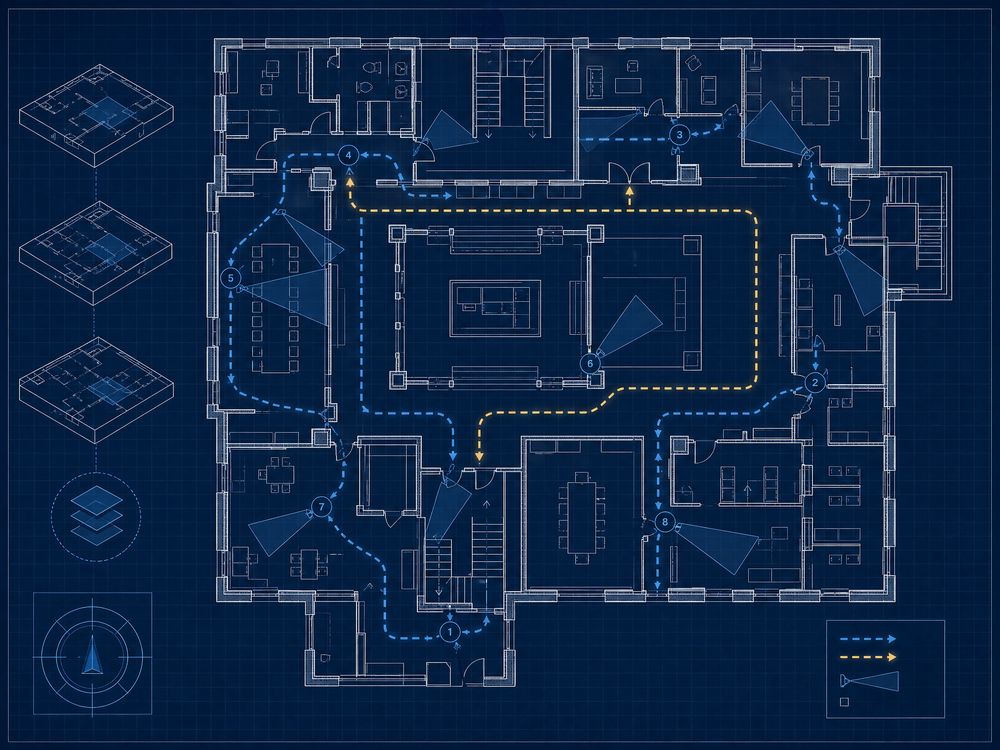
Blueprint diagram of overlapping guard patrol cones across a floor plan

The guard who remembers: a stealth game built on one clever list

Stealth 52 hours Desktop, handheld Iona Brackley

Load-bearing systems. One idea carries this entire game. Each guard maintains a short written record of what they have noticed — a moved crate, an unlocked door, a colleague who has not reported in — and each entry fades at a predictable rate you can learn to count. Every other system is built on top of that record. The gadgets are ways of writing to it or erasing from it. The level design is a set of arguments about how many entries you can afford to leave behind.

Friction points. The one place it grinds is the mission scoring, which rewards leaving no trace at all. That sits awkwardly against a memory system whose whole pleasure is managing traces rather than avoiding them. We suspect the scoring predates the memory model and was never revisited.

What breaks under stress. Very little, and we tried. Around hour forty the guard count in later levels grows enough that tracking six overlapping memories becomes bookkeeping rather than tension, but the game ends before that becomes a real problem.

Sound structure
Core loop92
Endurance81
Access74
Stability88

Published 14 July 2026

Blueprint diagram of a hexagonal tactics grid with unit range overlays

A tactics game that forgot to make the mid-game hard

Tactics 46 hours Desktop Devraj Ollerton

Load-bearing systems. Line of sight and elevation, handled with unusual care. Height gives you accuracy and costs you cover, and the maps are built so that almost every position offers that trade in a slightly different shape. For eight hours this is genuinely superb, and the tutorial missions teach it without a single tooltip.

Friction points. The upgrade economy hands out roughly eleven per cent more capability per mission than the enemy roster gains. Individually both curves are reasonable. Together they mean that by mission fourteen your squad has outgrown everything the game can field, and the elevation trade stops mattering because you no longer need cover.

What breaks under stress. Mission fourteen, precisely. We can name it because two of us hit the same wall independently, four days apart, without having discussed it. Everything after that point is administration.

Holds with caveats
Core loop84
Endurance48
Access79
Stability86

Published 2 July 2026

Blueprint schematic of a transit network with junctions and platform detail

The transit builder whose save file cannot keep up with its own city

Simulation 61 hours Desktop, laptop Marged Fenwick

Load-bearing systems. Junction design. Not the timetable, not the finances, not the zoning — the geometry of where two lines cross and what that costs in throughput. The game models this properly, including the way a badly angled interchange strangles capacity two stations away, and the moment you understand it the whole thing opens up.

Friction points. Finances are a distant second concern and the game keeps insisting they matter. Loan interest and fare adjustments occupy the same amount of interface as the junction editor, despite contributing perhaps a tenth as much to how a city develops.

What breaks under stress. The save routine. Somewhere around four hundred thousand daily passengers, autosaves begin taking eleven to fourteen seconds on our fastest machine, and the game does not pause cleanly while they run. On the laptop it reached twenty-six seconds and we stopped the test. This is a hard ceiling on the most interesting thing the game does, which is to let a network grow large enough to develop its own problems.

Holds with caveats
Core loop89
Endurance57
Access66
Stability41

Published 19 June 2026

Blueprint cutaway drawing of a light aircraft cockpit instrument panel

A flight sim with a superb aircraft and a hostile front end

Simulation 38 hours Desktop Hal Renshaw

Load-bearing systems. The aircraft itself, modelled to a standard that made a former glider pilot on our bench go quiet for several minutes. Ground effect, crosswind behaviour on a short runway, the way the airframe complains before it does anything dangerous — all of it assembled with obvious care by people who have flown the real thing.

Friction points. Between that aircraft and the person who wants to fly it sit eleven menus. Four require a mouse and cannot be driven from a stick or keyboard. Two engine start procedures exist and nothing explains when to use which. The friction here is not between two game systems but between the simulation and its own front door.

What breaks under stress. Nothing in the flight model, which held up across every condition we could set. What breaks is the reader we are writing for: three of the six of us bounced off the setup before reaching a runway, and one needed a written checklist from a colleague to get airborne at all.

Our access score of twenty-nine drew the sharpest letter we have received. We stand by it, and we have published the disagreement in full.

Holds with caveats
Core loop94
Endurance83
Access29
Stability77

Published 5 June 2026

Blueprint drawing of a test bench with four labelled computers

A roguelike where the meta-progression argues with the run

Roguelike 74 hours Desktop, handheld Priya Alnwick

Load-bearing systems. The single-run economy, which is tight, legible and genuinely tense. Resources have three competing uses at all times and the game never lets you satisfy more than two. Sixty of our seventy-four hours were spent enjoying exactly this.

Friction points. A permanent upgrade tree sits on top of that economy and works against it. The run wants scarcity; the tree exists to remove scarcity. After twenty unlocks the early floors no longer pose the three-way squeeze that made them interesting, and the game's answer is to make later floors longer rather than harder.

What breaks under stress. Nothing technical. What erodes is the reason to keep playing: by hour sixty the runs have become reliable, and reliability is the one thing this genre cannot survive. We would rather have had no tree at all.

Holds with caveats
Core loop90
Endurance55
Access82
Stability91

Published 21 May 2026

Blueprint drawing of a workshop wall panel with pinned notes

An adventure game that trusts you to remember things

Adventure 22 hours Desktop, laptop, handheld Iona Brackley

Load-bearing systems. A refusal to keep a quest log. Information arrives in conversation, is never written down for you, and matters four hours later. This sounds like a hostility to the reader and turns out to be the opposite: because nothing is recorded, the game can afford to make every detail meaningful, and it does.

Friction points. There is one puzzle in the third act that depends on a detail mentioned once, in passing, by a character you can miss entirely. That is the system failing on its own terms rather than a difficulty choice, and it cost two of us an evening each.

What breaks under stress. Nothing, and at twenty-two hours the game is short enough that nothing has a chance to. We note that the no-log design has an accessibility cost the game does not acknowledge or offer to mitigate, which is the main reason our access bar sits where it does.

Sound structure
Core loop87
Endurance88
Access52
Stability93

Published 8 May 2026

Blueprint cutaway drawing of a console with labelled internal sections

A survival game with two systems that should never have met

Simulation 44 hours Desktop Callum Byker

Load-bearing systems. Base construction, which is unusually good at making a shelter feel like it was assembled rather than placed. Walls have thickness that matters, roofs leak where you would expect them to, and repairing something badly leaves a visible scar you will look at for the rest of the run.

Friction points. The game also has a generous teleport network, added in a later patch, that lets you return to base from anywhere in about eight seconds. Everything the construction system was doing — making distance from shelter feel consequential — is neutralised by that convenience. Two competent systems, pointed directly at each other.

What breaks under stress. The hunger and temperature model, which is calibrated for a world you cross on foot. With teleports, both meters become notifications rather than pressures. By hour thirty we were not surviving anything; we were commuting.

Structurally unsound
Core loop63
Endurance34
Access71
Stability69

Published 24 April 2026

No teardowns filed under that genre yet. We publish about three a month, so the gaps fill in slowly. Try All to see the full set.

Reading the four bars

Note · Scale

The bars are not a review score broken into pieces. They are four separate measurements that happen to share a scale, and a game can sit at ninety on one and thirty on another without any contradiction. A high core loop with a low endurance figure describes something excellent that runs out; the reverse describes something merely adequate that never gets worse. Both are useful things to know, and averaging them would destroy the information.

Full definitions, including what each bar counts and what it deliberately ignores, are on the procedure sheet.